Project Info
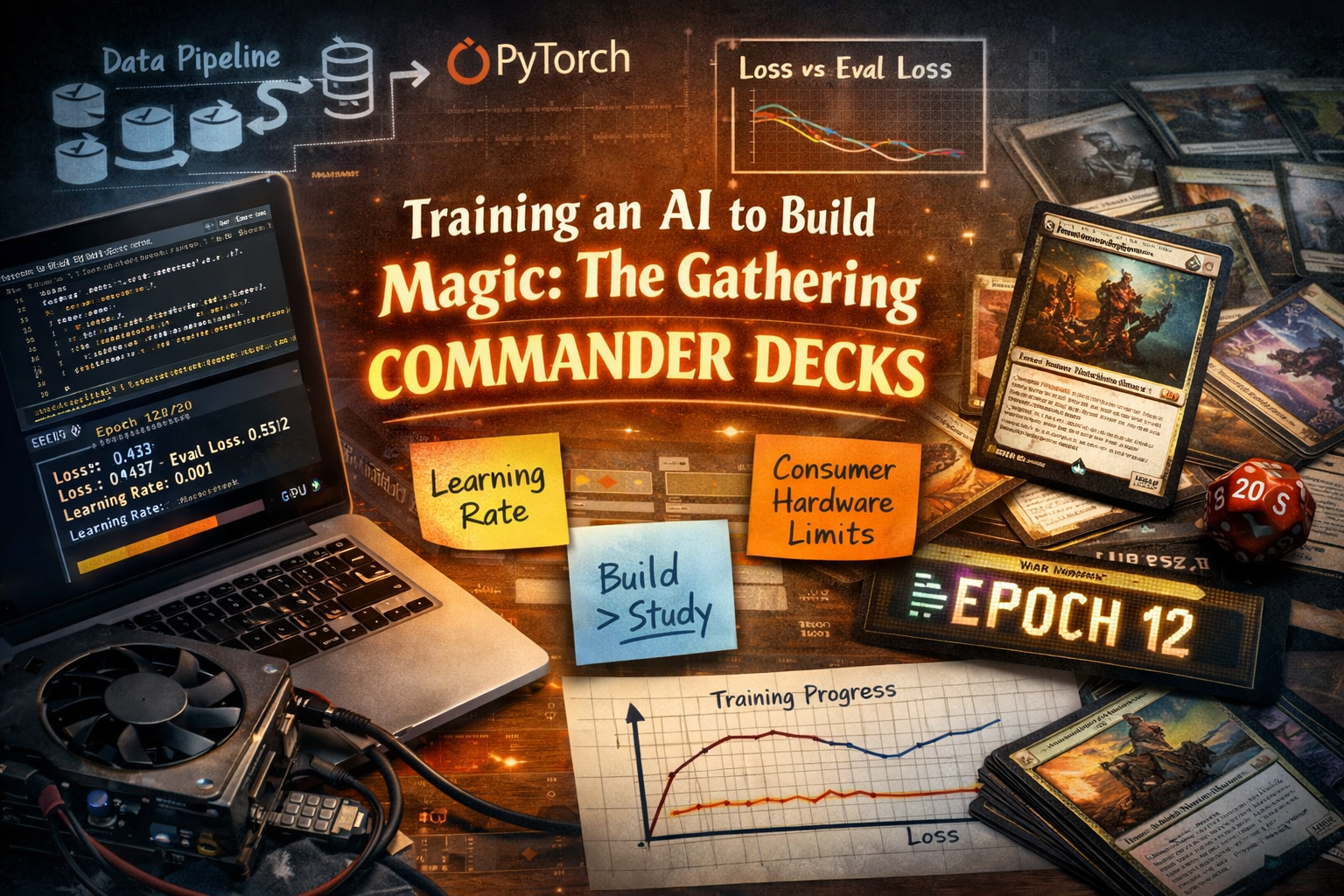
Building a Commander Deckbuilding AI, Part 0: Why This Exists
The Problem
I started playing Magic: The Gathering in the mid-90s. Back then, there were maybe a thousand cards in the game. As a kid, I could memorize most of them. I knew what was good, what was bad, and what beat what.
Fast forward to 2026. There are over 30,000 cards, and the format everyone is playing is Commander, a format that did not even exist when I was slinging cards at the kitchen table. I found out about its popularity and decided to check it out. I found a group of people just like me, dads looking for a night away from the kids and a break from the everyday. I was hooked again.
But the game had changed completely. The card pool was massive, the strategies were layered, and I had no idea what I was doing. So I did what anyone would do in 2026. I asked AI for help.
The results were terrible.
What AI Gets Wrong About Magic
I asked ChatGPT and other models to help me build and improve Commander decks. The recommendations were bad across the board. Cards that did not synergize with my commander. Cards that made my deck worse, not better. Cards that were not even legal in the format. If I had followed its advice, I would have spent thousands of dollars on cards I did not need.
The problem was not that the models were stupid. They just did not have the right knowledge. General-purpose LLMs know that Magic exists and can name some cards, but they do not understand deckbuilding. They do not know what a good mana curve looks like, which cards actually get played together in real decks, or why a card that looks strong on paper is actually bad in a specific strategy. They hallucinate card names, ignore format legality, and give advice that sounds confident but falls apart the moment you sit down at a table.
Why Build It Myself
My career has been pointing more and more toward AI-based projects. I needed to understand the full lifecycle of building a real AI system, not just the theory. Data pipelines, model selection, the tradeoffs between RAG and fine-tuning, working within hardware constraints, evaluation, deployment. You do not learn that from reading blog posts. You learn it by building something.
So I decided to kill two birds with one stone. Build a ground-up AI project that solves a real problem I actually have, and use it to get hands-on experience with every stage of the AI development lifecycle.
The first iteration was a RAG system. RAG stands for retrieval-augmented generation. The idea is that instead of training a model, you give it a search tool. When someone asks a question, the model searches a knowledge base for relevant information and uses that to generate its answer. Think of it like an open-book exam versus studying for the test.
It did not work well. The model with RAG was not giving me noticeably different results from the model without it. The underlying problem was the same. The model did not understand Commander deckbuilding, and bolting a search engine onto it did not fix that.
So I picked the project back up with a different approach. Instead of retrieval, I would build a training pipeline. Collect real data, real decklists, real synergy scores, real card usage patterns, process it into high-quality training examples, and fine-tune an open-source model (Llama 3.1 8B) to actually learn the domain. The model should understand why a card fits a strategy, not just retrieve cards that look similar.
What Success Looks Like
If the model can help me build better Commander decks, it can help other people too. The goal is a tool that takes a decklist, listens to what problem you are having, and gives specific, justified recommendations. Cut this card because it is too slow for your strategy. Add this one because it covers a gap in your removal. Here is a budget option if the first pick is too expensive. Watch out, this card has a high salt score, your playgroup might not love it.
I will make it available for anyone who wants to use it, but you will have to run it on your own hardware. My GPU might explode if too many people try to hit it at once.